

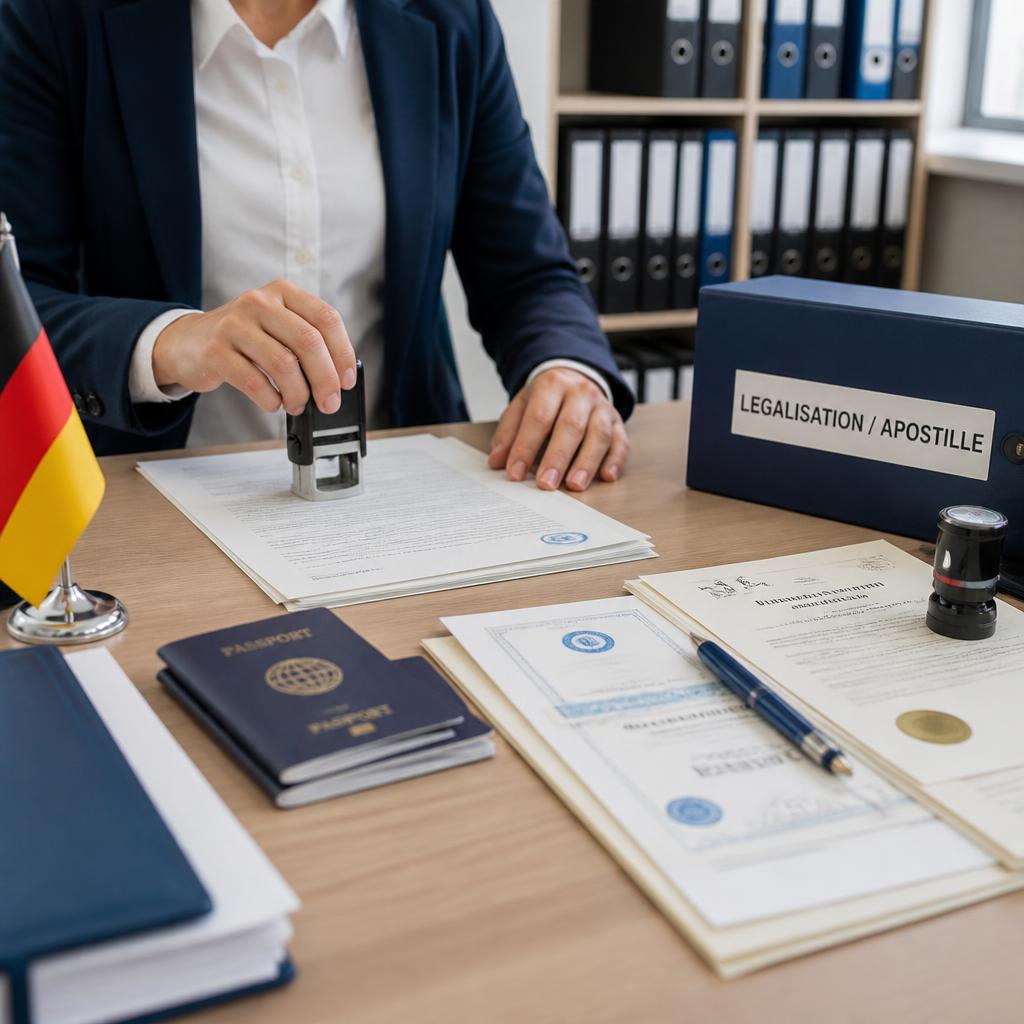
Using foreign documents in Germany can be more complicated than simply translating them and submitting them to a German authority. Depending on the country where a document was issued and the purpose for which it will be used, additional authentication, legalization, apostille, certification, or verification may be required.
Understanding the Common Document Legalization Mistakes in Germany is therefore important for anyone preparing documents for marriage registration, family reunification, divorce recognition, citizenship, residence applications, or other administrative procedures.
A document can be genuine but still fail to meet the formal requirements of the German authority receiving it. The German Federal Foreign Office explains that the procedure required for foreign public documents depends largely on the country where the document was issued and the international agreements applicable to that country.
This guide explains the Common Document Legalization Mistakes in Germany, why they happen, and how you can avoid unnecessary delays and additional costs.
What Is Document Legalization in Germany?
Document legalization is a procedure used to confirm the authenticity of certain foreign public documents so they can be used in Germany.
Foreign public documents may include documents issued by courts, government authorities, civil registry offices, or notaries. However, not every foreign document automatically requires legalization.
Depending on the country of origin, Germany may accept:
- Legalization by a German diplomatic mission
- A Hague Apostille
- An international certificate under a relevant convention
- A bilateral treaty arrangement
- An alternative verification procedure
The German Federal Foreign Office specifically states that the applicable procedure depends on the country where the document was issued.
This is why understanding the Common Document Legalization Mistakes in Germany before submitting your documents can save considerable time.
Common Document Legalization Mistakes in Germany
1. Assuming Every Foreign Document Needs Legalization
One of the most common mistakes is assuming that every foreign document must be legalized by a German embassy or consulate.
This is not always correct.
Some countries are covered by the Hague Apostille Convention. In those cases, an apostille may replace the traditional legalization procedure. Other countries may have bilateral agreements or other arrangements that affect the required procedure.
The German Federal Foreign Office confirms that foreign public documents may be subject to different authentication procedures depending on the country of origin.
Before starting the process, determine:
- Where was the document issued?
- Which authority issued it?
- Where will it be used in Germany?
- Is an apostille applicable?
- Is legalization required?
- Does a special verification procedure apply?
Failing to answer these questions is one of the major Common Document Legalization Mistakes in Germany.
2. Confusing Legalization With Certification
Legalization, certification, and notarization are not necessarily the same thing.
A certified copy confirms that a copy corresponds to the original under the applicable certification rules. Legalization concerns the authenticity of a foreign public document for use in another country.
German administrative law also distinguishes between different types of certification. For example, Section 33 of the German Administrative Procedure Act regulates the certification of copies of documents.
Therefore, having a document certified does not automatically mean that the document has been legalized.
This distinction is particularly important when an authority specifically requests proof of authenticity.
3. Getting an Apostille When Legalization Is Required
Another common mistake is obtaining an apostille simply because it is commonly used internationally.
An apostille is not universally applicable.
The Hague Apostille Convention applies only in relationships between states covered by the Convention. Where an apostille applies, it can replace legalization. Where it does not apply, another procedure may be required.
Before obtaining an apostille, check the rules applicable to the specific country where the document was issued.
Using the wrong authentication procedure can result in additional expenses and force you to repeat part of the process.
4. Using a Copy Instead of the Required Original
Another serious mistake is assuming that a photocopy is always sufficient.
For certain legalization procedures, the original public document must be presented. The German Federal Foreign Office explains that the Hague Apostille confirms the authenticity of the original public document and that the original must be submitted to the designated authority.
Therefore, before submitting a document, check whether the authority requires:
- Original document
- Certified copy
- Simple copy
- Recently issued original
- Electronic document
- Original plus authentication
Submitting the wrong format is among the Common Document Legalization Mistakes in Germany that can cause avoidable delays.
5. Translating the Document Without Checking the German Authority’s Requirements
Translation is another area where applicants frequently make mistakes.
A foreign document may need to be translated into German, but the requirements for the translation can depend on the German authority receiving the document.
The Federal Foreign Office states that when German authorities or courts require translations of foreign documents, they should generally be prepared by a sworn or certified translator in Germany. It also explains that translations themselves are not public documents and therefore cannot simply receive an apostille or legalization.
Before ordering a translation, check:
- Whether a German translation is required
- Whether the translation must be sworn or certified
- Whether the authority accepts translations completed outside Germany
- Whether the original document must accompany the translation
You can search for officially authorized, appointed, and sworn translators through the German state justice administrations’ official database.
6. Assuming Authentication Means the Document Is Automatically Accepted
Legalization confirms authenticity. It does not necessarily mean that the document satisfies every substantive or procedural requirement under German law.
This distinction is extremely important.
The German Federal Foreign Office explains that authentication of a foreign public document must be distinguished from whether that document fulfills the formal requirements of German domestic law.
For example, a document may be authentic but still not provide everything required for a particular legal procedure.
This means legalization should be viewed as one part of the document preparation process—not as a guarantee of acceptance.
7. Ignoring Special Rules for Documents From Certain Countries
Not all countries are treated identically.
Some countries have special arrangements with Germany, while in other countries traditional legalization may be suspended because German diplomatic missions cannot reliably verify the authenticity of documents through the normal process.
The Federal Foreign Office explains that legalization may be suspended in certain countries where there have been significant concerns about the authenticity or reliability of documents. In individual cases, a German authority may request verification through the competent German mission.
This is especially important for applicants using documents from countries with special authentication arrangements.
Therefore, never rely on a general statement such as:
“All foreign documents need an apostille.”
or:
“All foreign documents need embassy legalization.”
The correct procedure depends on the specific country and document.
8. Waiting Until the Last Minute
Document legalization can involve several authorities.
Depending on the situation, you may need to:
- Obtain the document from the issuing authority.
- Obtain prior certification.
- Obtain legalization or an apostille.
- Arrange an appropriate German translation.
- Prepare certified copies if required.
- Submit the documents to the German authority.
If one step is incorrect, you may need to repeat several steps.
This is why waiting until the deadline is one of the most expensive Common Document Legalization Mistakes in Germany.
Start the process as early as possible, particularly when the documents are required for:
- Family reunification
- Marriage registration
- Divorce recognition
- Citizenship applications
- Residence procedures
- Inheritance matters
- University or professional procedures
9. Assuming Old Documents Are Always Accepted
Some German procedures require documents issued recently or within a specific period.
A civil-status document that was acceptable several years ago may not necessarily satisfy the requirements of the authority today.
This can be particularly relevant for documents such as:
- Birth certificates
- Marriage certificates
- Family records
- Civil-status records
- Criminal-record certificates
- Residence-related documents
The exact validity period depends on the specific procedure and authority.
Therefore, before requesting authentication, confirm whether the German authority requires a recently issued document.
Obtaining legalization for an outdated document can become another of the Common Document Legalization Mistakes in Germany, because you may have to obtain and authenticate a new document again.
10. Assuming the German Embassy Always Handles the Entire Process
A German embassy or consulate can play an important role in document authentication, but it does not necessarily handle every stage of the process.
For foreign public documents that are eligible for legalization, the German diplomatic or consular mission in the country where the document was issued may perform the legalization. In countries covered by the Hague Convention, the designated authority in the country of origin generally issues the apostille instead.
In addition, German diplomatic missions can provide certain certification and notarization services for matters connected with the German legal system.
Therefore, you should first determine which authority is responsible for your specific procedure.
Why These Mistakes Can Cause Serious Delays
The consequences of document mistakes can extend beyond simply having to obtain another stamp.
An incorrect document can lead to:
- Additional appointments
- New translation costs
- Repeated certification fees
- Delays in visa procedures
- Delays in marriage registration
- Delays in citizenship applications
- Requests for additional documents
- Repeated trips to authorities
- Delayed submission of an application
In some cases, the problem may not become obvious until the documents are reviewed by the German authority.
This is why preventing the Common Document Legalization Mistakes in Germany is generally much easier than correcting them after submission.
Document Legalization for Marriage in Germany
Foreign marriage documents and civil-status documents may need authentication before they can be used in Germany.
However, the exact requirements depend on the issuing country and the German authority responsible for the procedure.
If you are planning to marry in Germany, it is important to check the requirements of the relevant Standesamt before preparing your documents.
You can also read our detailed guide:
Marriage Registration in Germany: Complete Legal Guide
This is especially important because authentication is only one part of the overall marriage-document process.
Document Legalization for Family Reunification
Family reunification applications often involve civil-status documents such as:
- Birth certificates
- Marriage certificates
- Family records
- Divorce documents
- Proof of family relationship
The German mission or visa authority may request specific forms of authentication and translation depending on the applicant’s circumstances and country of origin.
Our guide to Family Reunification Requirements in Germany explains the broader requirements of the family reunification process.
Avoiding Common Document Legalization Mistakes in Germany can help prevent document-related delays during the visa process.
Document Legalization for Divorce Recognition
If you obtained a divorce outside Germany and want the divorce to have legal effect in Germany, foreign divorce documents may require authentication and translation before they can be used in the relevant procedure.
However, authentication alone does not constitute recognition of the divorce.
The recognition process is separate and may involve the competent German authority.
You can learn more in our guide to Recognition of Foreign Divorce in Germany.
Document Legalization for German Citizenship
Citizenship applications can require extensive documentation concerning identity, civil status, residence, and family relationships.
Foreign documents submitted to German authorities may need to satisfy specific authenticity and translation requirements.
For applicants preparing citizenship documents, it is useful to review our guide on Documents Required for German Citizenship.
Again, the goal is not simply to legalize every document. The goal is to provide the correct document, in the correct form, authenticated through the correct procedure.
A Practical Checklist to Avoid Document Legalization Mistakes
Before submitting a foreign document in Germany, ask yourself:
Document Checklist
- Is this document actually required?
- Is it a public document?
- Which country issued it?
- Does that country use apostilles for Germany?
- Is legalization required instead?
- Is there a special verification procedure?
- Does the German authority require the original?
- Does the document need to be recently issued?
- Is a certified copy required?
- Is a German translation required?
- Does the translation need to be completed by a sworn or certified translator?
- Does the German authority have any additional requirements?
- Have you checked the current instructions rather than relying on old information?
This checklist can help you avoid many of the Common Document Legalization Mistakes in Germany.
How RBS Can Help
Preparing foreign documents for use in Germany can involve several different steps, and the correct procedure depends on the document, issuing country, and purpose.
At RBS, we help clients understand document requirements and prepare their files for procedures involving German authorities.
Our services can be relevant to cases involving:
- Family reunification
- Marriage registration
- Foreign divorce recognition
- Citizenship procedures
- Residence matters
- Official documents and certifications
- Powers of attorney and legal documentation
If you are unsure whether your document needs legalization, apostille, certification, translation, or another form of verification, obtaining professional guidance before starting the process can help you avoid unnecessary expenses and delays.
Frequently Asked Questions
Does every foreign document need legalization in Germany?
No. The required procedure depends on the issuing country, the type of document, applicable international agreements, and the German authority receiving the document.
Is an apostille the same as legalization?
No. An apostille can replace traditional legalization in countries covered by the Hague Apostille Convention. The applicable procedure depends on the country where the document was issued.
Can I submit a photocopy instead of the original?
Not necessarily. Certain procedures require the original document. You should follow the exact instructions of the authority handling the document.
Does legalization mean Germany automatically accepts my document?
No. Authentication confirms the document’s authenticity, but it does not automatically establish that the document satisfies every requirement of German law.
Can a normal translation be used?
It depends on the receiving authority. Where a German authority or court requires a translation, the Federal Foreign Office recommends using a sworn or certified translator in Germany.
What is the biggest document legalization mistake?
One of the biggest mistakes is starting the authentication process without first confirming exactly what the German authority requires. This can result in obtaining the wrong certification, translation, or authentication.
Final Thoughts
The Common Document Legalization Mistakes in Germany are often caused by a simple misunderstanding: assuming that all foreign documents follow the same procedure.
They do not.
The correct process depends on the country of origin, type of document, applicable international agreements, German authority, and purpose of the document.
Before spending money on legalization, apostilles, translations, or certifications, confirm the exact requirements for your case.
A few minutes of preparation can prevent weeks of unnecessary delays and avoidable costs.
If you are preparing foreign documents for marriage, family reunification, divorce recognition, citizenship, residence, or another procedure in Germany, RBS can help you understand the requirements and prepare your documents correctly.
Official Sources
- German Federal Foreign Office – International Document Traffic
- German Federal Foreign Office – Foreign Public Documents for Use in Germany
- German Federal Foreign Office – Apostille or Legalization
- German Federal Foreign Office – Legalization of Foreign Documents
- German Federal Foreign Office – Syria and Germany
- German Civil Code – Section 129: Public Certification
- German Administrative Procedure Act – Section 33: Certification of Documents