

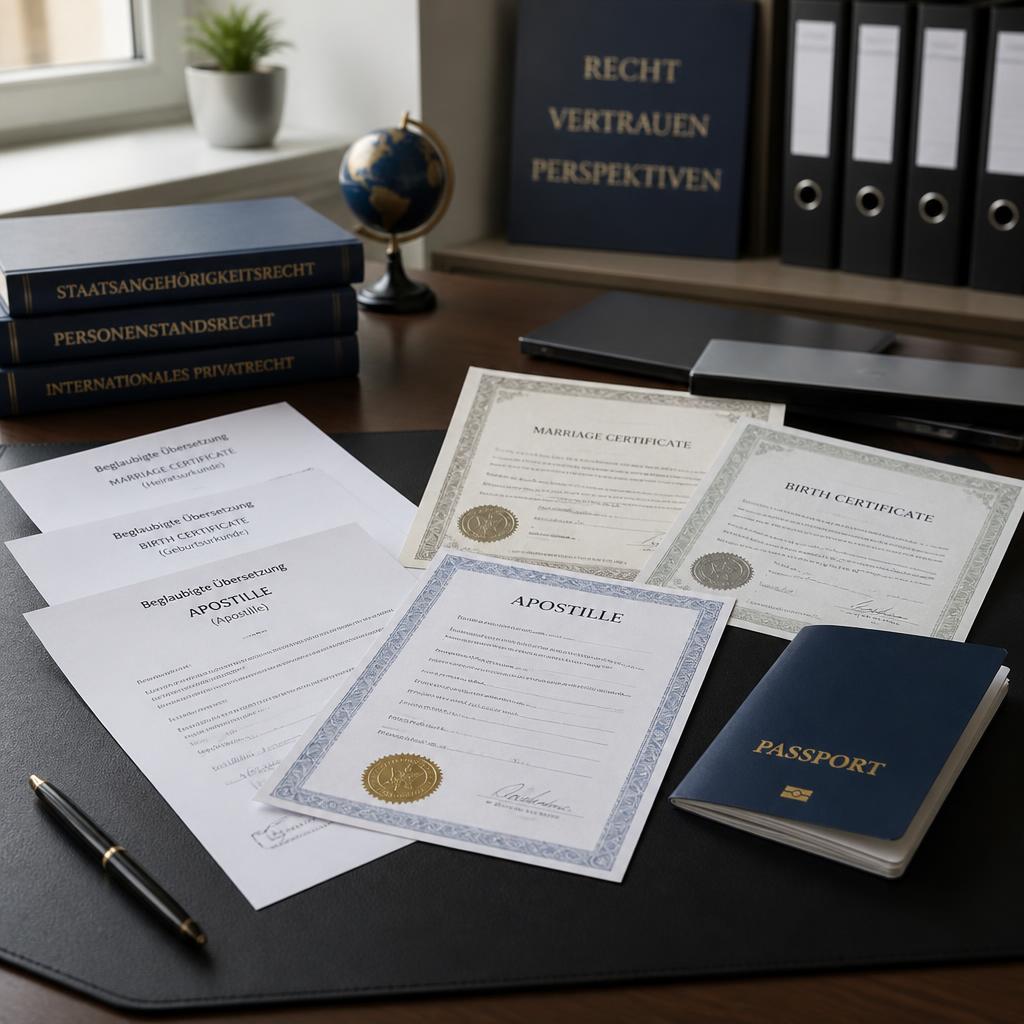
Do Marriage Documents Need Legalization in Germany?
If you are planning to get married in Germany and one or both partners are foreign nationals, one of the first questions you may have is: Do Marriage Documents Need Legalization in Germany?
The answer depends on several factors, including where the document was issued, what type of document it is, which international agreements apply, and what the responsible German authority requires.
Foreign documents submitted to German authorities may require a special procedure to confirm their authenticity. Depending on the country, this can involve legalization, an apostille, an exemption under an international convention, or another form of document verification.
For couples preparing to marry in Germany, the most important authority is usually the local Standesamt, or civil registry office. The Federal Foreign Office recommends contacting the responsible Standesamt first to determine exactly which documents are required and whether foreign documents must be translated or authenticated.
This guide explains Do Marriage Documents Need Legalization in Germany, when legalization or an apostille may be required, how translations work, and what foreign couples should check before submitting their marriage documents.
Do Marriage Documents Need Legalization in Germany?
There is no universal rule that every foreign marriage document must be legalized.
The Federal Foreign Office explains that when a foreign public document is presented to a German authority, the receiving authority may require proof of authenticity. The procedure depends primarily on the country where the document was issued and on applicable international agreements.
Depending on the circumstances, a foreign document may require:
- Legalization by a German diplomatic or consular mission.
- A Hague Apostille.
- Recognition under an international convention.
- Recognition under a bilateral agreement.
- An alternative document-verification procedure.
- No additional authentication at all.
Therefore, Do Marriage Documents Need Legalization in Germany? cannot be answered simply with “yes” or “no.”
The correct approach is to determine the requirements for each individual document before starting the authentication process.
What Is Legalization of Marriage Documents in Germany?
Legalization is a procedure used to confirm the authenticity of a foreign public document for use in Germany.
According to the Federal Foreign Office, foreign public documents that are not covered by certain international agreements can be legalized for use in Germany. Legalization is generally performed by consular officers of the German embassy or consulate in the country where the document was issued.
For example, depending on the country involved, a foreign birth certificate or civil-status document may need to go through a legalization procedure before it can be accepted by the relevant German authority.
However, legalization is not automatically required for every foreign document.
The applicable procedure depends on the country of origin and the specific document.
What Is an Apostille?
An Apostille is another method of authenticating public documents for international use.
It is based on the 1961 Hague Convention Abolishing the Requirement of Legalisation for Foreign Public Documents.
Where the Hague Apostille Convention applies, a public document generally does not need traditional legalization by the German diplomatic mission. Instead, an Apostille is issued by a designated authority in the country where the document was issued.
The Apostille confirms the authenticity of the signature, the capacity in which the person signing the document acted, and, where applicable, the identity of the seal or stamp.
The Federal Foreign Office explains that the Apostille is issued by the designated authority in the state that issued the document, meaning that applicants normally do not need to contact the German mission in that country for legalization.
Legalization vs. Apostille: What Is the Difference?
The two procedures are often confused.
| Legalization | Apostille |
|---|---|
| Used where no applicable exemption or convention replaces it | Used under the Hague Apostille Convention |
| Usually handled through the German diplomatic/consular mission in the issuing country | Issued by a designated authority in the issuing country |
| Depends on the country and document | Depends on whether the relevant Hague Convention rules apply |
| Can involve additional verification procedures | Generally replaces traditional legalization |
The Federal Foreign Office confirms that the applicable procedure depends on the issuing state and the international agreements relevant to the document.
Which Marriage Documents May Need Legalization in Germany?
The exact list depends on your personal circumstances and the requirements of the responsible Standesamt.
Foreign nationals planning to marry in Germany may be asked to provide documents such as:
- Birth certificate.
- Passport or identity document.
- Certificate of marital status.
- Certificate of no impediment to marriage, where applicable.
- Previous marriage certificate.
- Final divorce judgment, if previously married.
- Death certificate of a former spouse, where applicable.
- Proof of residence.
- Other civil-status documents.
The Federal Foreign Office specifically advises people planning to marry a foreign partner in Germany to contact the relevant Standesamt first and obtain information about the required documents. In many cases, foreign documents must also be translated and authenticated.
This is particularly important because the requirements can differ significantly depending on the nationality and circumstances of the foreign partner.
Do Foreign Birth Certificates Need Legalization in Germany?
A foreign birth certificate may need authentication before it can be used in Germany.
However, the exact procedure depends on the issuing country.
Depending on the circumstances, the birth certificate may require:
- An Apostille.
- Legalization.
- Alternative verification.
- No authentication because an international agreement applies.
The Federal Foreign Office explains that international agreements can create exemptions from ordinary legalization requirements. For example, certain multilingual civil-status documents issued under applicable International Commission on Civil Status conventions can be exempt from formalities in Germany.
Therefore, you should not automatically order an Apostille simply because the document is foreign.
Do Marriage Certificates From Another Country Need Legalization in Germany?
This question usually arises when a couple has already married outside Germany and wants to use the marriage certificate in Germany.
The foreign marriage certificate may need authentication before German authorities can accept it as evidence of the marriage.
The Federal Foreign Office explains that foreign marriage certificates are often accepted by German authorities or courts only after their authenticity or evidentiary value has been established through an appropriate procedure. Depending on the country where the marriage took place, this can involve legalization or an Apostille.
A German authority may also require a German translation of the foreign marriage certificate.
Is a Foreign Marriage Automatically Recognized in Germany?
A foreign marriage does not necessarily need to be separately registered in Germany to be valid there.
The Federal Foreign Office explains that a marriage concluded abroad is generally recognized in Germany when the substantive marriage requirements under the relevant laws were satisfied and the formal requirements of the law applicable at the place of marriage or the applicable national laws were fulfilled.
Registration of a foreign marriage in a German marriage register is not generally mandatory.
However, where at least one spouse is German, there may be an option to have the foreign marriage recorded in the German marriage register.
This is different from authenticating the foreign marriage certificate.
Do Foreign Marriage Documents Need a Certified German Translation?
In many cases, yes.
German authorities and courts often require foreign-language documents to be translated into German.
The Federal Foreign Office states that foreign documents are often required to have a German translation and recommends, where possible, using a German publicly appointed, sworn, or otherwise officially recognized translator.
However, the precise requirements can depend on the authority handling your case.
Before paying for a translation, it is therefore advisable to ask the Standesamt:
- Whether a translation is required.
- Whether the translation must be into German.
- Whether a sworn or officially recognized translator is required.
- Whether the translation must be completed in Germany.
- Whether the original document must be submitted together with the translation.
This can prevent unnecessary costs and delays.
What Documents Are Usually Checked by the Standesamt?
The Standesamt examines whether the legal requirements for the intended marriage have been satisfied.
Depending on the circumstances, the authority may need evidence concerning:
Identity
Passports or identity documents may be required to establish the identity of the future spouses.
Birth and personal status
Birth certificates and other civil-status documents may be required.
Previous marriages
If either partner was previously married, additional documentation may be required to establish that the previous marriage has legally ended.
This may include a final divorce judgment or a death certificate.
Marital capacity
The authority may need documents establishing that there is no legal impediment to the intended marriage.
The exact requirements depend on the circumstances and applicable law.
What About Documents From Syria?
For Syrian nationals, it is particularly important to obtain the exact requirements from the German authority handling the marriage procedure before preparing documents.
Do not assume that a Syrian document can automatically be used in Germany simply because it is an official document.
The Federal Foreign Office explains that for some countries, alternative verification procedures may apply instead of ordinary legalization. The procedure is determined by the state where the public document was issued.
Therefore, if the Standesamt requests Syrian civil-status documents, applicants should first clarify:
- Which documents are required.
- Which issuing authority must issue them.
- Whether originals are required.
- Whether authentication is possible.
- Whether an Apostille is applicable.
- Whether another verification procedure applies.
- Whether a German translation is required.
- Which translator is acceptable.
This is especially important because using the wrong authentication procedure can lead to additional costs and delays.
Common Mistakes With Marriage Document Legalization
Understanding Do Marriage Documents Need Legalization in Germany can help avoid several common mistakes.
1. Legalizing every document automatically
Not every foreign document necessarily requires legalization.
Some documents may be covered by international agreements or other exemptions.
2. Assuming every document needs an Apostille
An Apostille is not a universal replacement for every authentication procedure.
Its applicability depends on the issuing country and the relevant international framework.
3. Translating documents before checking the requirements
The authority may have specific requirements concerning the translator and format.
4. Using an ordinary translation
A translation from an unqualified translator may not satisfy the requirements of the authority handling the marriage procedure.
5. Submitting copies when originals are required
Authentication procedures can require the original public document. The Federal Foreign Office specifically notes that an original document must be submitted to the designated authority for an Apostille.
6. Following outdated information
Document requirements can change depending on international agreements and administrative procedures.
Always check the current requirements with the responsible authority.
How to Prepare Marriage Documents in Germany: Step-by-Step
If you are preparing to marry in Germany, the safest approach is:
Step 1: Contact the Standesamt
Start with the Standesamt responsible for your planned marriage.
Step 2: Request the exact document list
Ask for the requirements applicable to your nationality and personal circumstances.
Step 3: Identify the issuing country of every document
Authentication requirements depend heavily on where the document was issued.
Step 4: Check whether authentication is required
Determine whether the document requires:
- Apostille.
- Legalization.
- Alternative verification.
- No authentication.
Step 5: Check translation requirements
Confirm whether the document needs a German translation and what type of translator is accepted.
Step 6: Prepare the originals
Do not rely on ordinary copies unless the authority confirms that they are acceptable.
Step 7: Submit the complete file
Submit the documents according to the instructions of the Standesamt.
The Federal Foreign Office recommends this approach because the local Standesamt can provide the binding information about the documents needed for the intended marriage.
What If the Standesamt Requests Additional Documents?
This is possible.
A general checklist found online cannot guarantee that it covers every individual case.
The Standesamt may request additional documents if it needs further evidence concerning identity, marital status, previous marriages, or other legal requirements.
If you receive a request for additional documents, check exactly what the authority is asking for before ordering translations or authentication.
Marriage Documents and Family Reunification
Document preparation can also become important after marriage if the foreign spouse intends to live in Germany.
For example, a foreign spouse of a German citizen may need to apply for a visa for family reunification, subject to the applicable rules and any exemptions.
The Federal Foreign Office states that foreign spouses generally apply for a family reunification visa through the competent German mission abroad, subject to the applicable exceptions.
For this reason, properly preparing the marriage documentation can be an important part of the broader process.
For more information, see our related RBS article:
[Marrying a German Citizen in Germany: Complete Guide, Requirements & Citizenship (2026)]
Frequently Asked Questions
Do Marriage Documents Need Legalization in Germany?
Not always. The requirement depends on the issuing country, the type of document, and applicable international agreements. A document may require legalization, an Apostille, another verification procedure, or no additional authentication.
Do foreign marriage certificates need an Apostille in Germany?
Not necessarily. An Apostille is required only where the applicable international framework provides for it. The requirements should be checked based on the country where the certificate was issued.
Do I need to legalize my birth certificate before getting married in Germany?
It depends on the issuing country and the requirements of the responsible Standesamt.
Do foreign marriage documents need to be translated into German?
German authorities often require translations of foreign-language documents. The Federal Foreign Office recommends using a German publicly appointed, sworn, or recognized translator where possible.
Can I use a foreign marriage certificate in Germany without registering the marriage?
A foreign marriage does not generally have to be separately registered in Germany to be recognized, provided the applicable legal requirements for the marriage were fulfilled.
Where can I find out exactly which documents I need?
The responsible Standesamt should be your first point of contact. It can tell you which documents are required for your particular circumstances.
Final Checklist
Before submitting marriage documents in Germany, check:
- I contacted the responsible Standesamt.
- I received the exact document requirements.
- I checked the country where each document was issued.
- I confirmed whether legalization is required.
- I confirmed whether an Apostille is applicable.
- I checked whether an alternative verification procedure applies.
- I confirmed whether German translations are required.
- I checked the translator requirements.
- I prepared the required originals.
- I checked whether additional documents are required because of a previous marriage.
- I followed the current instructions of the responsible German authority.
Conclusion
So, Do Marriage Documents Need Legalization in Germany?
The answer depends on the individual document and the country where it was issued.
Foreign public documents used in Germany may require legalization, an Apostille, another authentication procedure, or no additional authentication, depending on applicable international agreements and the requirements of the German authority.
For couples planning to marry in Germany, the safest approach is to contact the responsible Standesamt before obtaining translations, Apostilles, or legalization. This allows you to determine exactly which documents are required and which authentication procedure applies.
For foreign nationals, especially those whose civil-status documents were issued outside Germany, preparing the correct documents from the beginning can help avoid unnecessary delays and additional costs.
External Sources
- Federal Foreign Office – Foreign Public Documents for Use in Germany
Foreign Public Documents for Use in Germany - Federal Foreign Office – Marriage to a Foreign Partner in Germany
Marriage to a Foreign Partner in Germany - Federal Foreign Office – International Recognition and Legalization of Documents
International Recognition and Legalization of Documents - Federal Foreign Office – Documents for Registering a Foreign Marriage in Germany
Documents for Registering a Foreign Marriage in Germany - Federal Foreign Office – Recognition of a Marriage Concluded Abroad
Recognition of a Marriage Concluded Abroad