

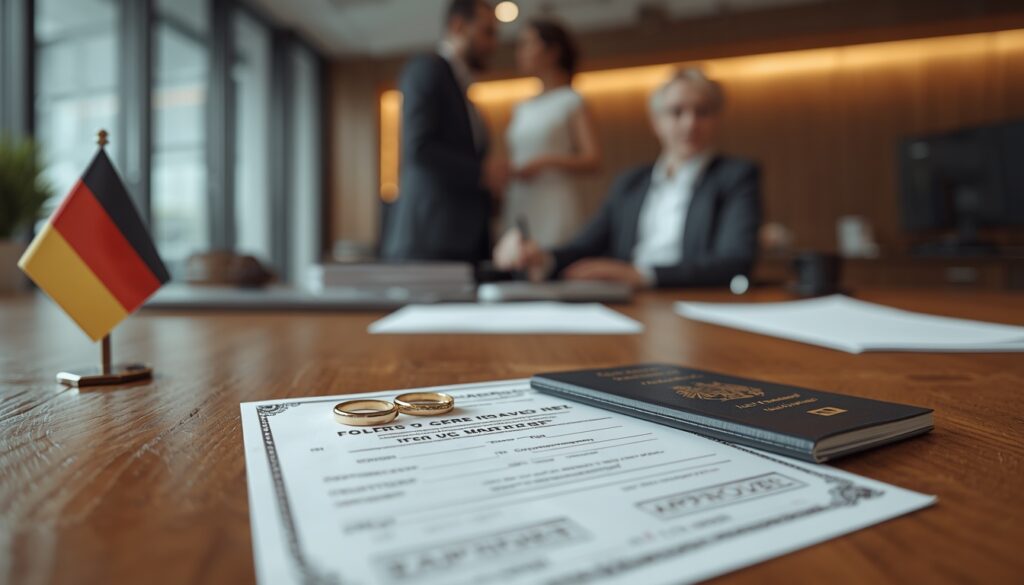
Foreign Marriage Recognition in Germany is an essential legal process for many international couples who plan to live, work, or settle in Germany. If you were married outside Germany, understanding how German authorities assess foreign marriage certificates can help you avoid delays and unnecessary legal complications.
Many people mistakenly believe that every foreign marriage certificate is automatically accepted by German authorities. In reality, recognition depends on several legal and administrative factors, including the country where the marriage took place, the authenticity of the marriage documents, and the purpose for which the marriage certificate is being presented.
Whether you need your marriage recognized for family reunification, a residence permit, taxation, inheritance, or other legal matters, understanding the applicable procedures can save you significant time, costs, and unnecessary delays.
This guide explains everything you need to know about the recognition of foreign marriages in Germany in 2026, including the legal framework, required documents, common challenges, and practical recommendations for a smoother process.
- Is a Foreign Marriage Automatically Recognized in Germany?
- When Is Marriage Recognition Necessary?
- Which Foreign Marriages Are Accepted?
- Foreign Marriage Recognition in Germany: Requirements and Process
- Certified Translation Requirements
- Legalization and Apostille
- Registration of a Foreign Marriage
- Recognition for Family Reunification
- Common Reasons for Rejection
- Frequently Asked Questions
- How Professional Assistance Can Help
Is a Foreign Marriage Automatically Recognized in Germany?
One of the most common misconceptions is that every marriage performed abroad must first receive formal recognition by a German court before it can be used in Germany.
In many situations, this is not the case.
As a general principle, Germany recognizes marriages that were legally concluded under the laws of the country where the marriage took place, provided that the marriage does not violate fundamental principles of German public policy (ordre public). However, recognition in practice may still require additional administrative steps depending on the authority involved and the purpose for which the marriage certificate is submitted.
For example, a marriage certificate may be accepted by one authority after proper legalization and certified translation, while another authority may request additional documentation or registration before processing an application.
Because requirements vary depending on the specific legal matter, applicants should avoid assuming that acceptance by one authority guarantees acceptance by all others.
Why Foreign Marriage Recognition in Germany Matters
Having a foreign marriage recognized—or ensuring that the necessary documentation is accepted—can be essential for a wide range of legal and administrative procedures in Germany.
These include:
- Applying for family reunification visas
- Obtaining or extending residence permits
- Registering a family status with German authorities
- Applying for German citizenship
- Tax classification for married couples
- Social security and health insurance benefits
- Pension entitlements
- Inheritance matters
- Child registration
- Birth registration of children
- Name declaration procedures
- Property ownership and financial transactions
Without properly accepted marriage documentation, many of these procedures may be delayed or suspended until the required evidence is provided.
Which Foreign Marriages Can Be Recognized?
In general, Germany accepts foreign marriages when several key legal conditions are satisfied.
These include:
The Marriage Was Legally Performed
The marriage must have been legally concluded under the laws of the country where it took place.
Civil marriages are generally easier to verify because they are officially registered with the competent civil authorities.
Religious marriages may also be recognized if they have legal effect under the national law of the country where the marriage was celebrated. However, purely religious ceremonies without legal civil registration may not be sufficient for administrative purposes in Germany.
The Marriage Is Properly Documented
Applicants are usually expected to provide an official marriage certificate issued by the competent authority.
Depending on the country of origin, German authorities may request:
- Original documents
- Certified copies
- Apostille certification
- Legalization
- Certified German translations
Failure to provide authentic and verifiable documentation may result in delays or requests for additional evidence.
The Marriage Does Not Conflict with German Public Policy
German authorities may refuse to recognize a foreign marriage if it fundamentally conflicts with German legal principles.
Examples may include marriages involving prohibited degrees of relationship or other circumstances that are incompatible with German law.
Each case is assessed individually according to the applicable legal framework.
Foreign Marriage Recognition in Germany: Requirements and Process
The exact documentation required may vary depending on your country of marriage, your nationality, and the German authority handling your case. However, most applicants are generally expected to provide the following documents.
Original Foreign Marriage Certificate
The original marriage certificate issued by the competent authority in the country where the marriage took place is usually the primary document required.
German authorities may refuse photocopies unless they have been officially certified.
If multiple versions of the marriage certificate exist, applicants should provide the official long-form certificate whenever possible.
Valid Passports or Identity Documents
Both spouses are generally required to present valid identification documents.
These may include:
- Passport
- National identity card (where applicable)
- German residence permit of the sponsoring spouse
- Registration certificate (Meldebescheinigung), if requested
Authorities use these documents to verify identity and confirm the legal residence status of the applicant or sponsor.
Certified German Translation
Documents issued in languages other than German are usually required to be translated by a certified translator.
Translations should accurately reflect every detail contained in the original document, including:
- Names
- Dates
- Official stamps
- Signatures
- Registration numbers
Inaccurate or unofficial translations may result in additional requests from the competent authority and prolong the processing time.
Apostille or Legalization
One of the most frequently misunderstood aspects of foreign marriage recognition is the authentication of official documents.
Depending on the country where the marriage certificate was issued, German authorities may require either:
Apostille
Countries that are parties to the Hague Apostille Convention generally issue an Apostille certificate, which confirms the authenticity of the public document for international use.
Legalization
For countries that are not part of the Apostille Convention, legalization procedures may be required through the competent authorities and the relevant German diplomatic mission.
The applicable procedure depends entirely on the country that issued the marriage certificate.
Because international authentication requirements vary, applicants should verify the correct procedure before submitting their documents.
Do You Need to Register Your Foreign Marriage in Germany?
Many couples assume that every foreign marriage must be officially registered in Germany immediately after arrival.
This is not always correct.
In many cases, a legally valid foreign marriage is already recognized for various administrative purposes once the required documentation has been accepted.
However, voluntary registration with the German civil registry office (Standesamt) may still be beneficial.
Registration can simplify future administrative procedures such as:
- Obtaining German marriage certificates
- Name declarations
- Birth registration of children
- Family records
- Future dealings with German authorities
Whether registration is necessary depends on the individual circumstances and the purpose for which the marriage documentation will be used.
Recognition of Foreign Marriage for Family Reunification
One of the most common reasons couples seek recognition of a foreign marriage is to apply for family reunification in Germany.
During the family reunification process, German authorities generally verify:
- The legal validity of the marriage.
- The authenticity of the submitted documents.
- Compliance with German immigration requirements.
- Identity of both spouses.
- Whether additional documentation is required.
Submitting complete and properly authenticated documents from the beginning can significantly reduce delays during visa processing.
Applicants should remember that recognition of the marriage alone does not automatically guarantee approval of a family reunification visa. Immigration authorities will also assess all other legal requirements applicable to the specific case.
Step-by-Step Process for Using a Foreign Marriage Certificate in Germany
Although procedures differ depending on the authority involved, the process generally includes the following steps:
Step 1 – Obtain the Official Marriage Certificate
Request the official marriage certificate from the competent authority in the country where the marriage was registered.
Step 2 – Authenticate the Document
If required, complete the appropriate authentication procedure through Apostille or legalization, depending on the issuing country.
Step 3 – Obtain a Certified German Translation
Have the document translated into German by a qualified certified translator if requested by the receiving authority.
Step 4 – Prepare Supporting Documentation
Gather any additional documents requested for your specific procedure, such as passports, residence permits, proof of address, or civil status records.
Step 5 – Submit the Documents
Submit the complete documentation to the relevant German authority responsible for your case, such as the immigration office, civil registry office, or German diplomatic mission abroad.
Step 6 – Respond to Additional Requests
Authorities may request clarification or supplementary documents during the review process.
Providing prompt and accurate responses can help avoid unnecessary delays.
Common Reasons Why Foreign Marriage Documents May Be Rejected
Although many foreign marriages are legally valid, administrative issues can delay or complicate their acceptance by German authorities. Understanding the most common reasons for document rejection can help applicants prepare a complete and accurate file.
Incomplete Documentation
Missing documents are one of the leading causes of delays. Authorities may request additional paperwork if essential records are not included with the application.
Always verify the document checklist before submission.
Missing Apostille or Legalization
Many applicants submit marriage certificates without completing the required authentication process.
If your country requires legalization or an Apostille, failure to obtain it may prevent German authorities from accepting the document.
Incorrect or Uncertified Translation
German authorities often require certified German translations.
Translations that contain errors, missing pages, or unofficial formatting may lead to additional requests or delays.
Inconsistent Personal Information
Names, dates of birth, passport numbers, or other personal details must be consistent across all submitted documents.
Even small discrepancies can trigger additional verification procedures.
Doubts About Document Authenticity
If the issuing authority cannot be verified or the document appears altered or incomplete, German authorities may conduct additional checks before proceeding.
Providing original documents whenever requested can help reduce unnecessary delays.
How to Avoid Delays During the Recognition Process
Preparing your documents carefully before submission can significantly improve the efficiency of the process.
Consider the following recommendations:
- Obtain official documents from the competent authority.
- Verify whether Apostille or legalization is required.
- Use certified German translations where applicable.
- Ensure that all personal information is consistent across every document.
- Keep certified copies of all submitted documents.
- Respond promptly to any requests from the responsible authority.
- Seek professional guidance if your case involves unusual legal circumstances.
Proper preparation can save considerable time and reduce the likelihood of repeated document requests.
Frequently Asked Questions (FAQ)
Is a foreign marriage automatically recognized in Germany?
In many cases, a marriage legally concluded abroad is recognized in Germany if it is valid under the law of the country where it was celebrated and does not conflict with fundamental principles of German law. Depending on the administrative procedure involved, additional documentation, authentication, or registration may still be required.
Do I need to register my foreign marriage in Germany?
Not always.
Registration with the German civil registry office is optional in many situations but may simplify future administrative procedures, such as obtaining German marriage certificates or registering children.
Do I need an Apostille for my marriage certificate?
It depends on the country that issued the document.
Some countries issue an Apostille under the Hague Convention, while others require legalization through the competent authorities and the German diplomatic mission.
Can I use my foreign marriage certificate for family reunification?
Yes, provided that the marriage is legally valid and the required documentation has been properly prepared and accepted by the competent German authorities.
Additional immigration requirements for family reunification will also apply.
How long does the recognition process take?
Processing times vary depending on the authority involved, the country where the marriage was registered, and whether additional verification is required.
Incomplete documentation may significantly increase processing times.
Do all documents need to be translated into German?
Documents issued in languages other than German are frequently required to be translated by a certified translator.
The specific requirements depend on the authority handling the case.
How long does Foreign Marriage Recognition in Germany take?
The duration of Foreign Marriage Recognition in Germany depends on the documents provided, the country where the marriage took place, and the responsible German authorities.
Why Professional Assistance Can Make a Difference
International marriage documentation often involves multiple authorities, authentication procedures, translations, and legal requirements.
Professional guidance can help applicants:
- Understand the applicable legal requirements.
- Prepare complete documentation.
- Avoid common administrative mistakes.
- Reduce unnecessary delays.
- Navigate complex international procedures more confidently.
Every case is unique, and individual circumstances should always be considered before submitting official applications.
For official information regarding civil status matters, applicants should consult the Federal Foreign Office.
Information about residence permits is also available from the Federal Office for Migration and Refugees (BAMF).
Conclusion: Understanding Foreign Marriage Recognition in Germany
Having a foreign marriage recognized or accepted for legal and administrative purposes in Germany is an important step for many couples planning to live, work, or build their future together.
While Germany generally recognizes legally valid foreign marriages, the practical requirements may differ depending on the issuing country, the authority involved, and the purpose of the application. Ensuring that your documents are authentic, properly translated, and correctly authenticated can help prevent delays and simplify the overall process.
Because each case is unique, taking the time to understand the applicable requirements—and seeking professional guidance when necessary—can make the process smoother and more predictable.
Need Assistance With Your Foreign Marriage Documents?
At RBS Global, we provide professional administrative support for individuals and families dealing with international documentation and legal procedures related to Germany.
Our services include assistance with:
- Foreign marriage documentation
- Family reunification procedures
- Certified document preparation
- International document legalization
- Administrative guidance for German authorities